Bringing immigration casework into the digital age
Bringing immigration casework into the digital age
Bringing immigration casework into the digital age
Designing data-powered products and processes at DHS
Designing data-powered products and processes at DHS
Situation
Department of Homeland Security needed to decrease its increasing case backlog and urgently transition its fragmented, paper-based national security vetting and case management for asylum and refugee cases into a unified, digital platform guided by a human-centered design strategy.
Goals
Setting priorities that balanced operational needs and officer realities with regularly issued Executive Orders by working closely with stakeholders across DHS and USCIS to set objectives to modernize case processing, fortify security screening, and decrease adjudication times.
Process
As immigration challenges grew more urgent, we focused on putting people first. By listening, testing ideas quickly, and working hand-in-hand with those on the ground, we built tools that made managing cases simpler and security checks more reliable, helping systems work better for everyone involved.
My role
As the UX Lead for three years across different teams and flexing into a hybrid PM role for one year on a team, I supported teams in tackling complex challenges throughout the adjudication lifecycle. By leading my team through rigorous mixed methods research, we were able to map and streamline workflows to eliminate inefficiencies. Partnering with designers and engineers, I led the iterative design, testing, and deployment of new features like real-time sharing of applicant data across systems and case reporting tools. Project highlights include:


I continuously facilitated alignment across diverse stakeholders on priorities that were critical to success.
Our team worked closely with two key parts of U.S. immigration:
Primary stakeholder: Refugee, Asylum, and International Operations (RAIO)
Secondary stakeholder: Fraud Detection & National Security (FDNS), as well as their partners across the DHS
RAIO Officers, or Adjudicating Officers, process and make decisions on refugee and asylum cases with their supervisors and broader teams. They evaluate humanitarian benefits and conduct thorough security checks to protect both newcomers and the country.
FDNS Officers and DHS partners use data and investigation processes to uncover security risks, partnering with law enforcement and training adjudicators to keep the system fair and secure.
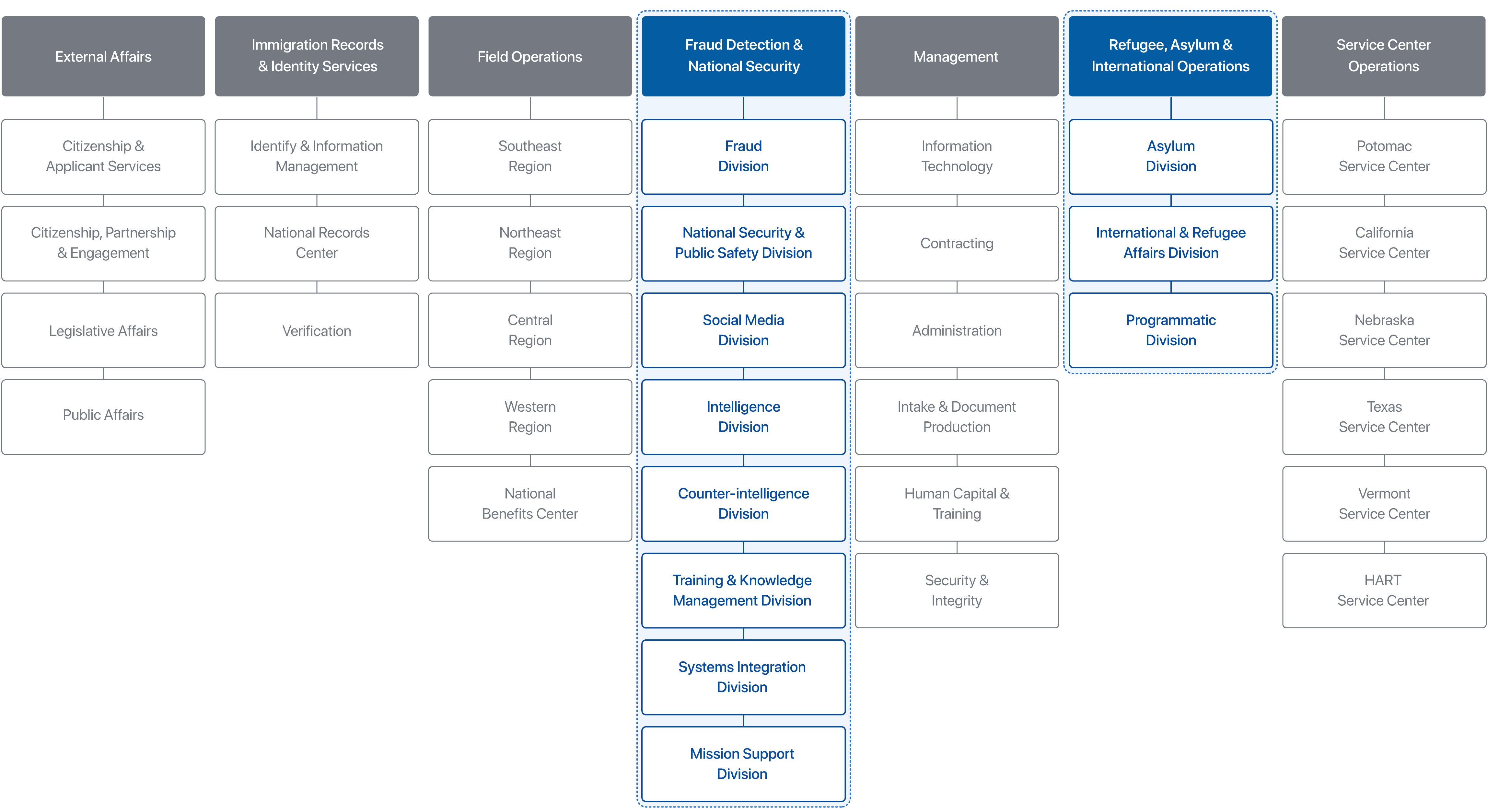
My team's challenges cut across multiple workflows, systems and priorities.
Our challenge was to modernize how asylum and refugee cases are managed. By building a digital case management system connected to other systems in advanced ways, we helped speed up case processing and improve security checks.
This allowed us to reimagine outdated paper-based workflows and translate them into better processes, leveraging digital touchpoint to expedite processes. In addition to these changes saving time, they also strengthened what data was shared across systems and how frequently systems could share data.
Example Priorioty: Operation Allies Welcome
This work became especially vital during Operation Allies Welcome, where these tools helped the U.S. swiftly support Afghans seeking safety, including those who had stood by us during difficult times. It was about building systems that could meet the moment with speed, security, and humanity.
The challenges to resolve cut across multiple systems and workflows.
We rolled up our sleeves to tackle a big challenge: modernizing how asylum and refugee cases are managed. By connecting RAIO’s case management system, Global, with other systems across USCIS and DHS, we helped speed up processing and improve security checks.
We also reimagined outdated paper-based workflows, turning them into efficient digital processes. These changes didn’t just save time—they strengthened fraud detection and security measures, ensuring cases were handled both quickly and carefully.
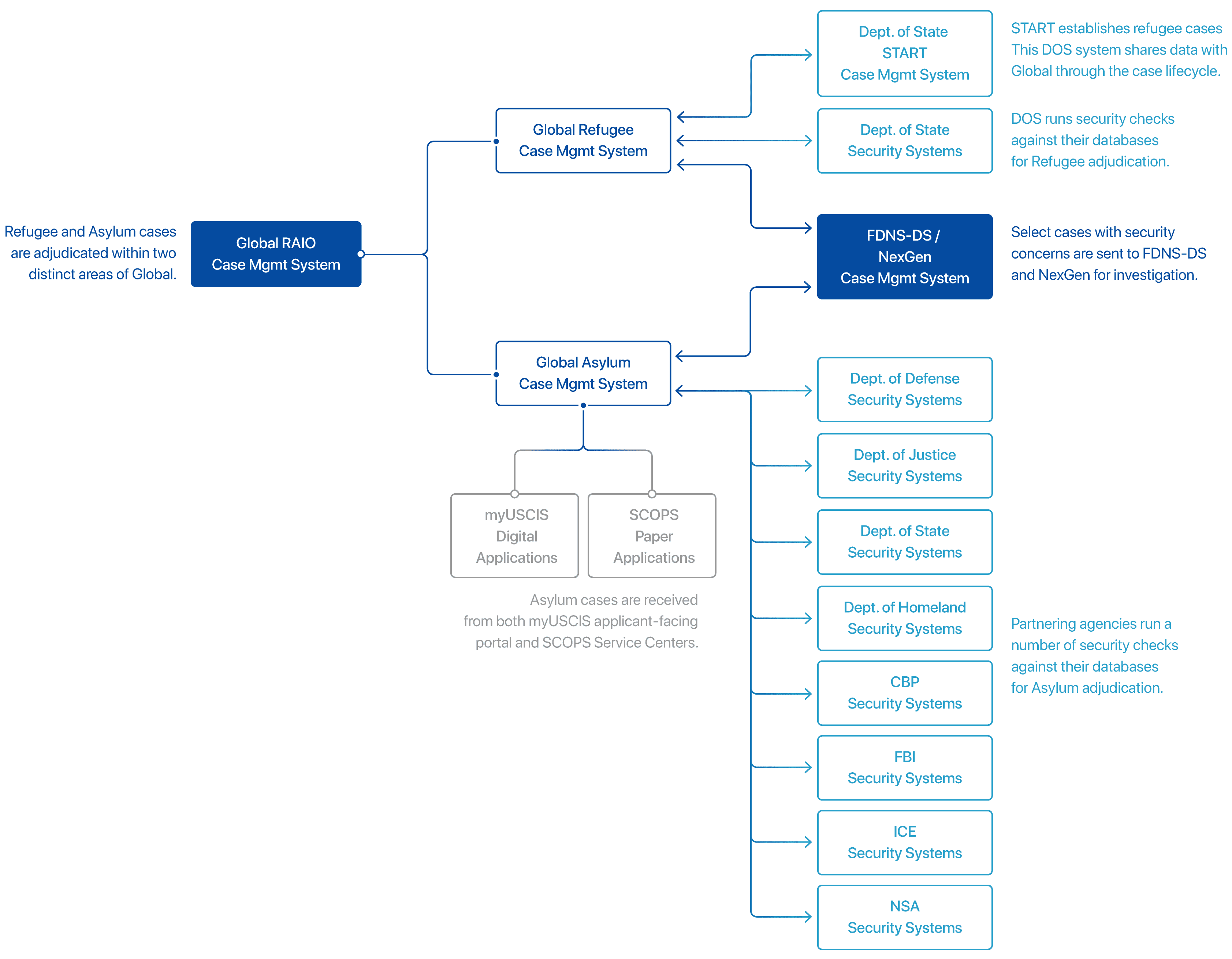
Through interviews and contextual inquiry with Officers, we mapped the complex current state experience of adjudication.
To understand the heart of asylum and refugee casework, we dove deep into how these processes actually work. We mapped out every step, from managing cases and running security checks to making final decisions. Along the way, we uncovered the many people and systems involved in making it all happen. Here’s the big picture of how these cases move forward:
Through in-depth research, we mapped the experience of adjudication across roles and case types.
To understand the heart of asylum and refugee casework, we dove deep into how these processes actually work. We mapped out every step, from managing cases and running security checks to making final decisions.

Asylum Casework Experience

Asylum Officers are responsible for completing meticulous interviews with asylum seekers, reviewing supporting documentation, and making informed decisions about whether to grant or deny asylum. This involves applying multifaceted legal standards, assessing credibility, and ensuring national security. Challenges in this role include managing a high caseload, navigating language barriers, and ensuring accuracy in decision-making. Additionally, staying updated on evolving immigration laws and policies is essential to effectively adjudicate cases.
Refugee Casework Experience

Adjudicating refugee cases is a complex and demanding task. Officers must meticulously review each case, assessing the refugee's eligibility based on international law and U.S. immigration regulations. This involves analyzing supporting documentation, conducting interviews, and conducting thorough security checks. Challenges include managing a high volume of cases, navigating cultural differences, and ensuring timely processing while maintaining rigorous standards. Additionally, staying updated on evolving refugee policies and international humanitarian law is crucial to making informed decisions.
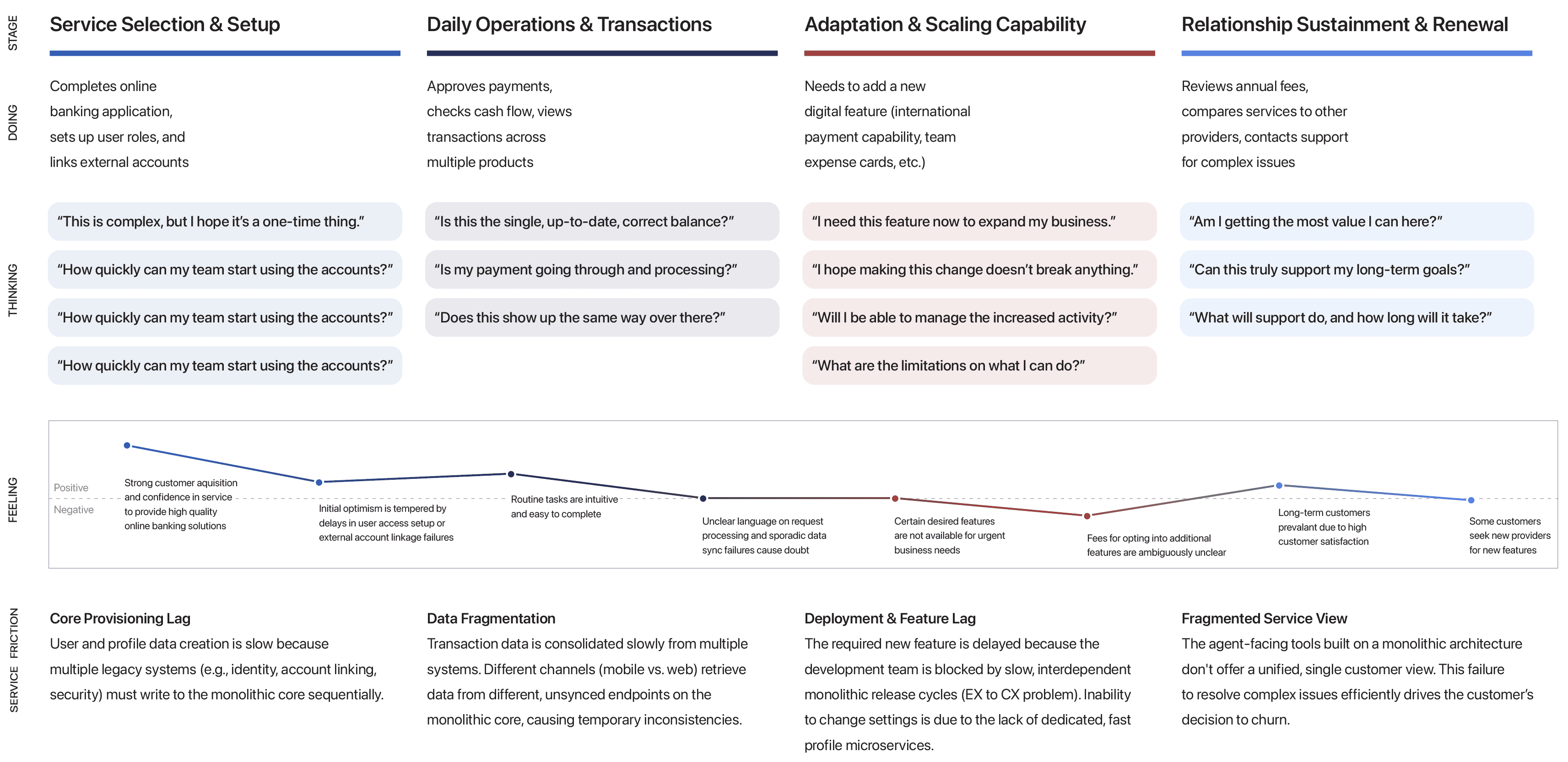
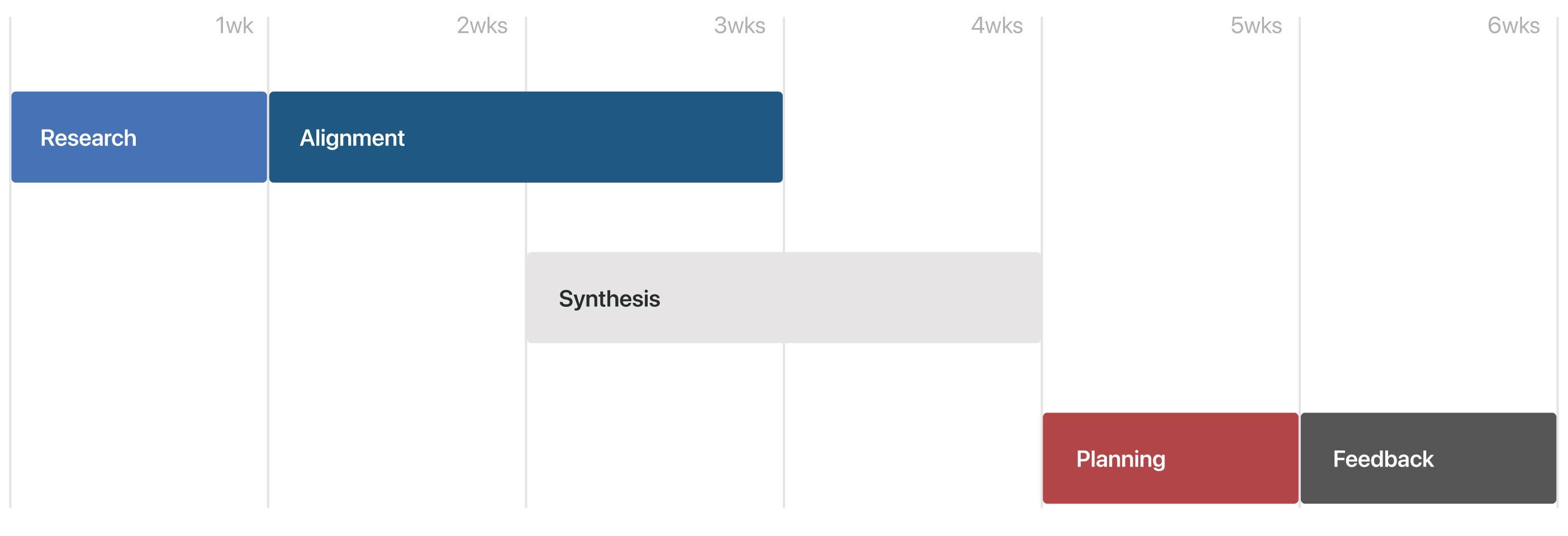
As priorities shifted with new demands, we maintained a responsive and contextual roadmap.
As the world of asylum and refugee casework kept changing, our team stayed nimble, working hand-in-hand with stakeholders and government agencies to meet urgent needs head-on. Two of the many priorities we focused on were improving security checks and strengthening security guidance, steps that made the system work better for everyone involved.
As priorities shifted with new demands, we maintained a responsive and contextual roadmap.
As the world of asylum and refugee casework kept changing, our team stayed nimble, working hand-in-hand with stakeholders and government agencies to meet urgent needs head-on. We focused on delivering solutions that made a real difference, like:
Speeding Up Case Processing: We created tools to help cases move faster and reduce backlogs.
Stronger Security Checks: We built smarter systems to keep the process secure and ensure fairness.
By staying connected and adapting quickly, we tackled some of the toughest challenges in asylum and refugee case management. Two of the many priorities we focused on were improving security checks and strengthening security guidance, steps that made the system work better for everyone involved.

Priority 1: Improving Security Checks
To make background and security checks faster and more reliable for asylum and refugee cases, we started by listening
and learning. We spent time understanding how officers handled these checks and uncovered a few big challenges:
• Information was hard to find: Critical data was trapped in separate systems, creating delays and frustration.
• Too much manual work: Officers were doing repetitive tasks by hand, slowing things down and leaving room for mistakes.
• Security gaps: Paper files and disconnected digital systems made it harder to protect sensitive information.
Priority 1: Improving Security Checks
To make background and security checks faster and more reliable for asylum and refugee cases, we started by listening and learning. We spent time understanding how officers handled these checks and uncovered a few big challenges:
• Information was hard to find: Critical data was trapped in separate systems.
• Too much manual work: Officers were doing repetitive tasks by hand.
• Security gaps: Paper files and disconnected systems made it harder to protect information.
Priority 1:
Improving Security Checks
To make background and security checks faster and more reliable for asylum and refugee cases, we started by listening and learning. We spent time understanding how officers handled these checks and uncovered a few big challenges:
Information was hard to find: Critical data was trapped in separate systems, creating delays and frustration.
Too much manual work: Officers were doing repetitive tasks by hand, slowing things down and leaving room for mistakes.
Security gaps: Paper files and disconnected digital systems made it harder to protect sensitive information.

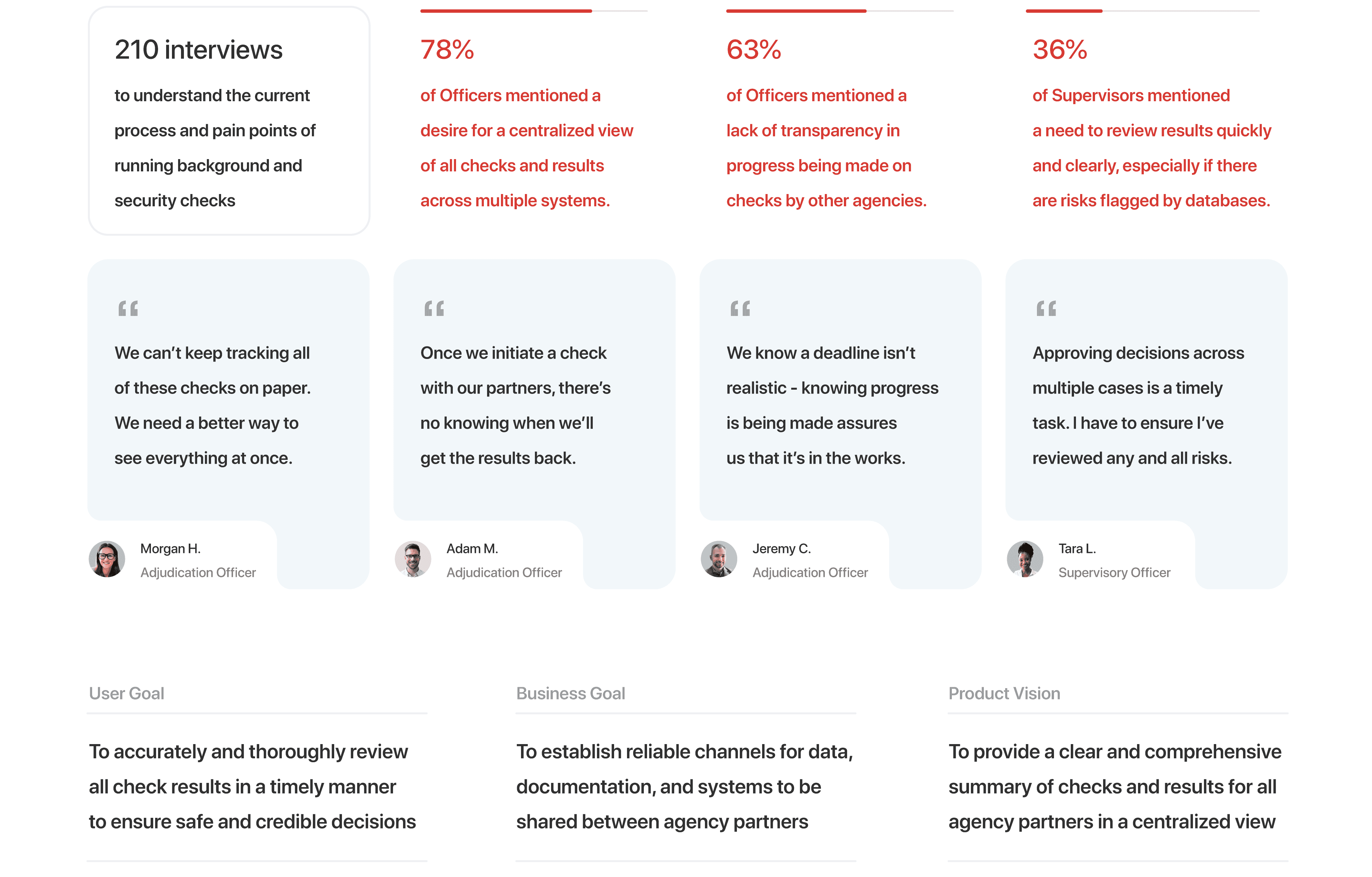
Research Insights
We sat down with officers, veterans and newcomers alike, to hear about the real challenges they face every day. Their stories helped us pinpoint where the system was falling short and inspired a clear vision for making background checks faster, simpler, and more effective.
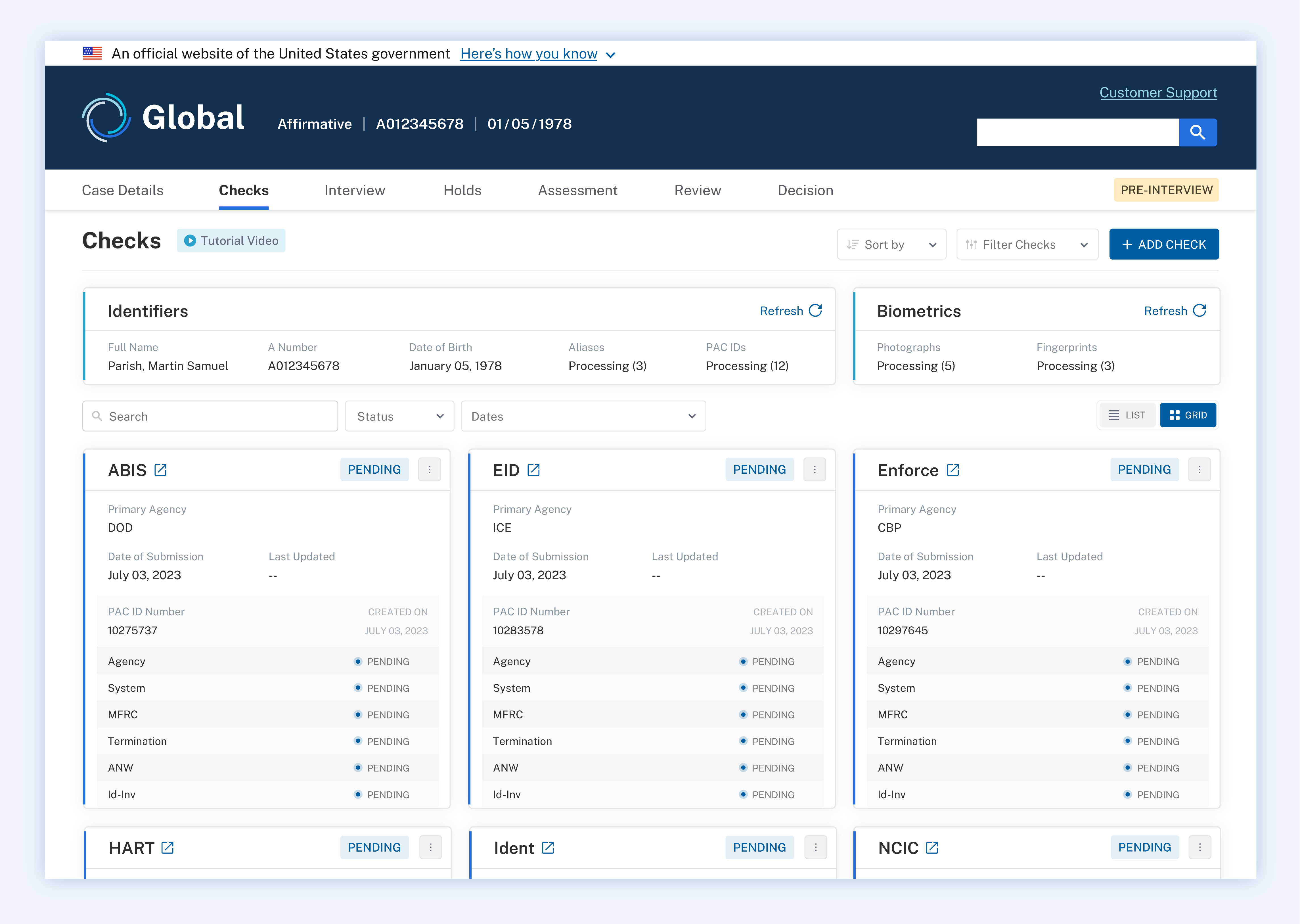
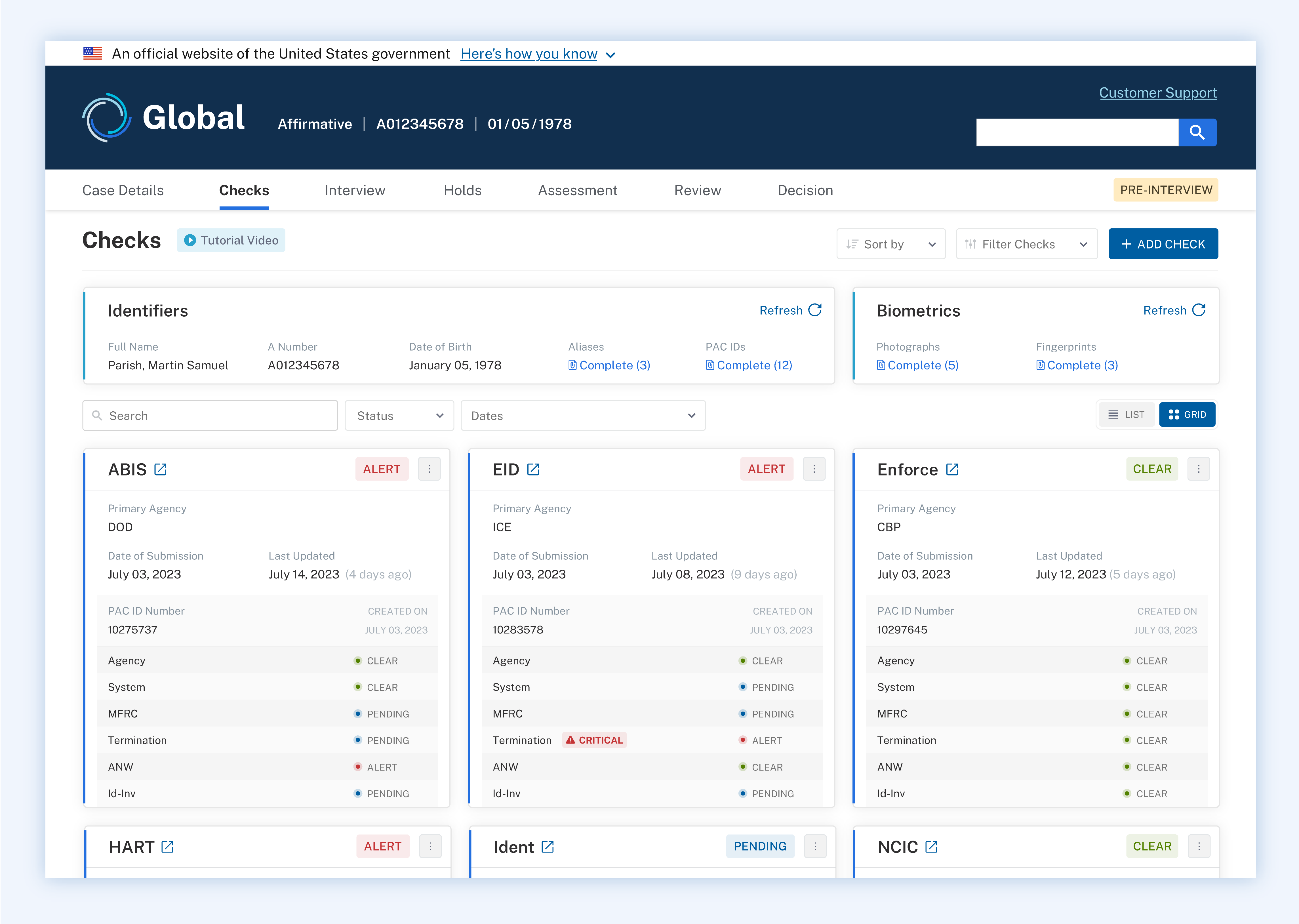
To realize the product vision, I designed a dashboard prototype aimed at presenting information in a central,
user-friendly manner and roadmapped to integrate with all key partners, starting with the most
high impact partner data.
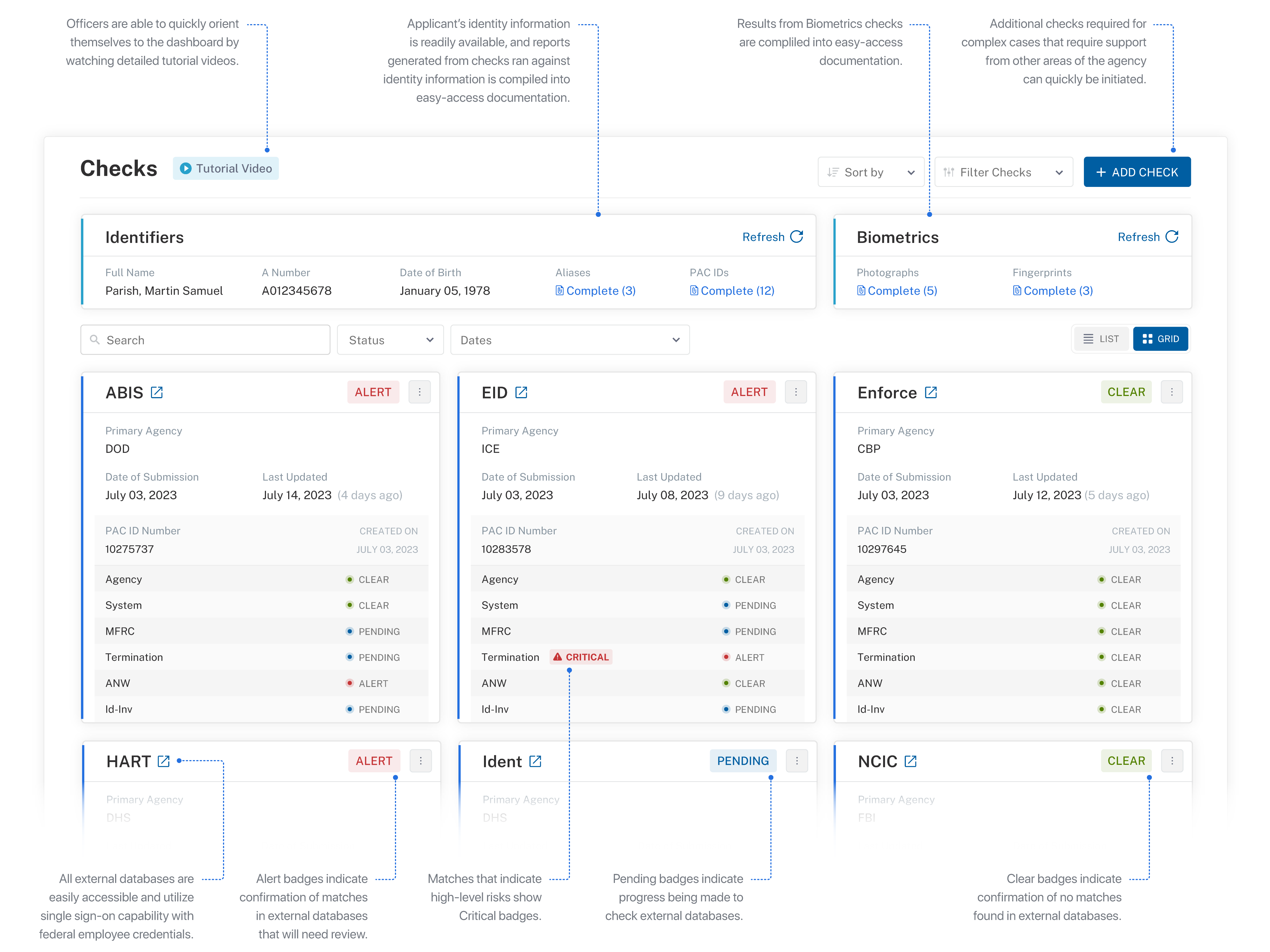
This design pulled data from different agencies into a single dashboard, making it easier for Officers to find what they needed. It also automates routine tasks, freeing up time for officers to focus on more tedious, time-consuming actions during casework. The design also adds safeguards to protect sensitive information and keep the system secure. This was build and put into production with a roadmap for integrations to support a robust logic for identity and security checks.
To address the problems we uncovered, we designed a dashboard powered by a robust set of data integrations.
Our research showed we needed to bring information together, cut out repetitive tasks, and tighten security. Here’s how we tackled it:
Centralized Data: We pulled data from different agencies into a single dashboard, making it easier for officers to find what they needed.
Smarter Workflows: We automated routine tasks, freeing up time for officers to focus on the work that truly matters.
Stronger Security: We added safeguards to protect sensitive information and keep the system secure.
By connecting Global with other systems and building this centralized dashboard, we made background and security checks faster, safer, and more efficient, helping asylum and refugee case management run smoother for everyone involved.
Priority 2: Strengthening Security Guidance
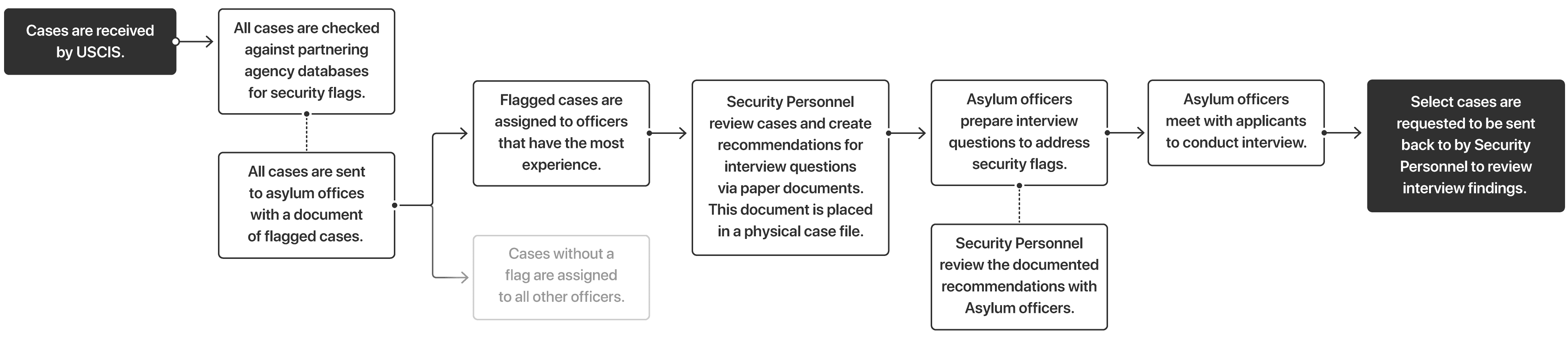
While working to improve security screenings, we discovered a major gap: officers interviewing high-risk applicants often didn’t get the guidance they needed in time. The old paper-based system was slow and left officers scrambling to prepare. Here’s what we found:
• Paper was the problem: Critical security details were stuck in piles of paperwork, causing unnecessary delays.
• Guidance came too late: Officers often received important information after it was useful, leaving them underprepared.
• Training fell short: Many officers didn’t have the tools or training to confidently handle high-risk cases.
Research Insights
We spent time talking to officers, listening to their daily struggles, and learning where the system was falling short. Their insights shaped our vision for a better way to deliver security guidance, one that’s faster, clearer, and more helpful when it matters most.

To ensure this coordination across Officers, I designed a digital workflow to ensure timely communication.
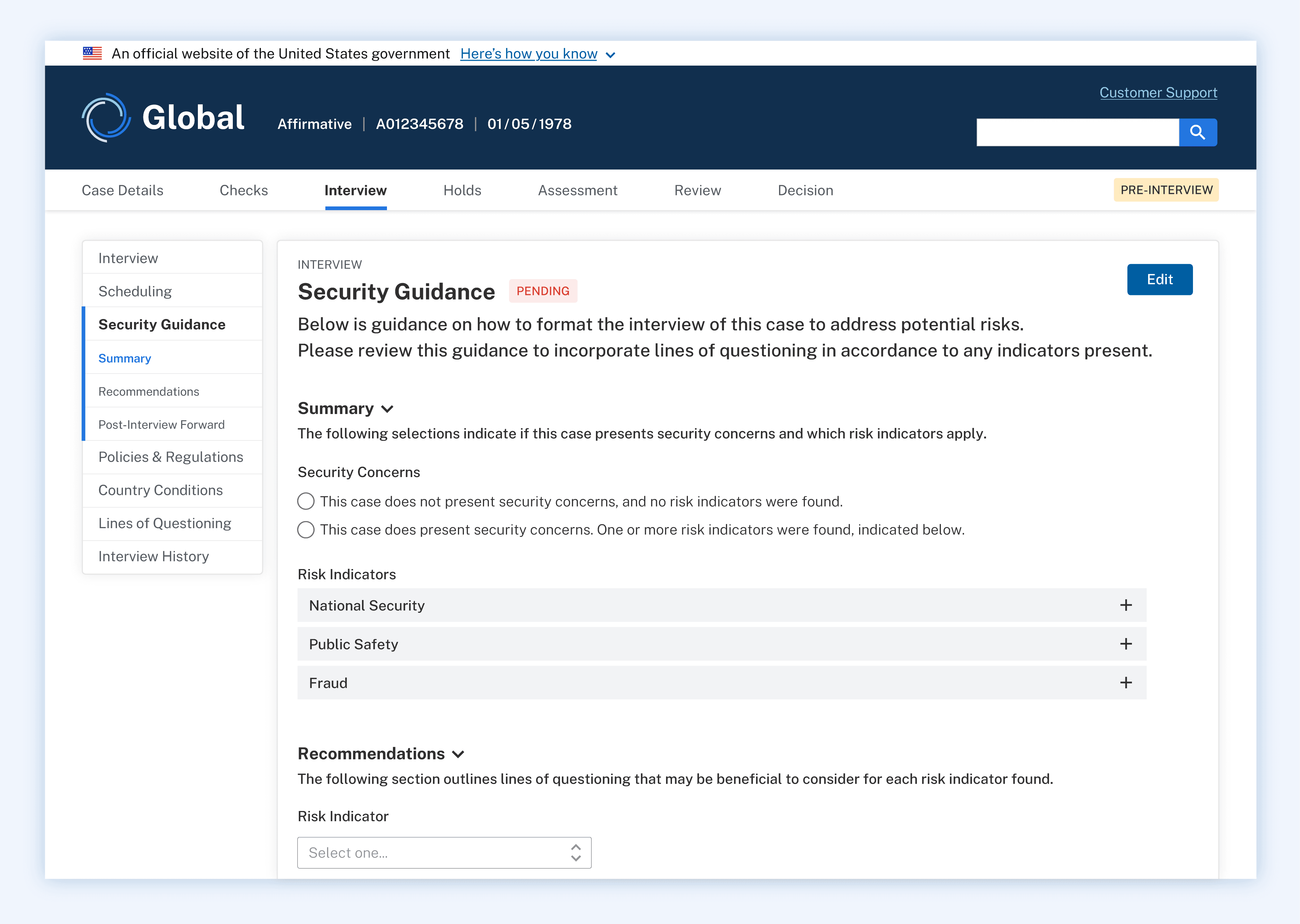
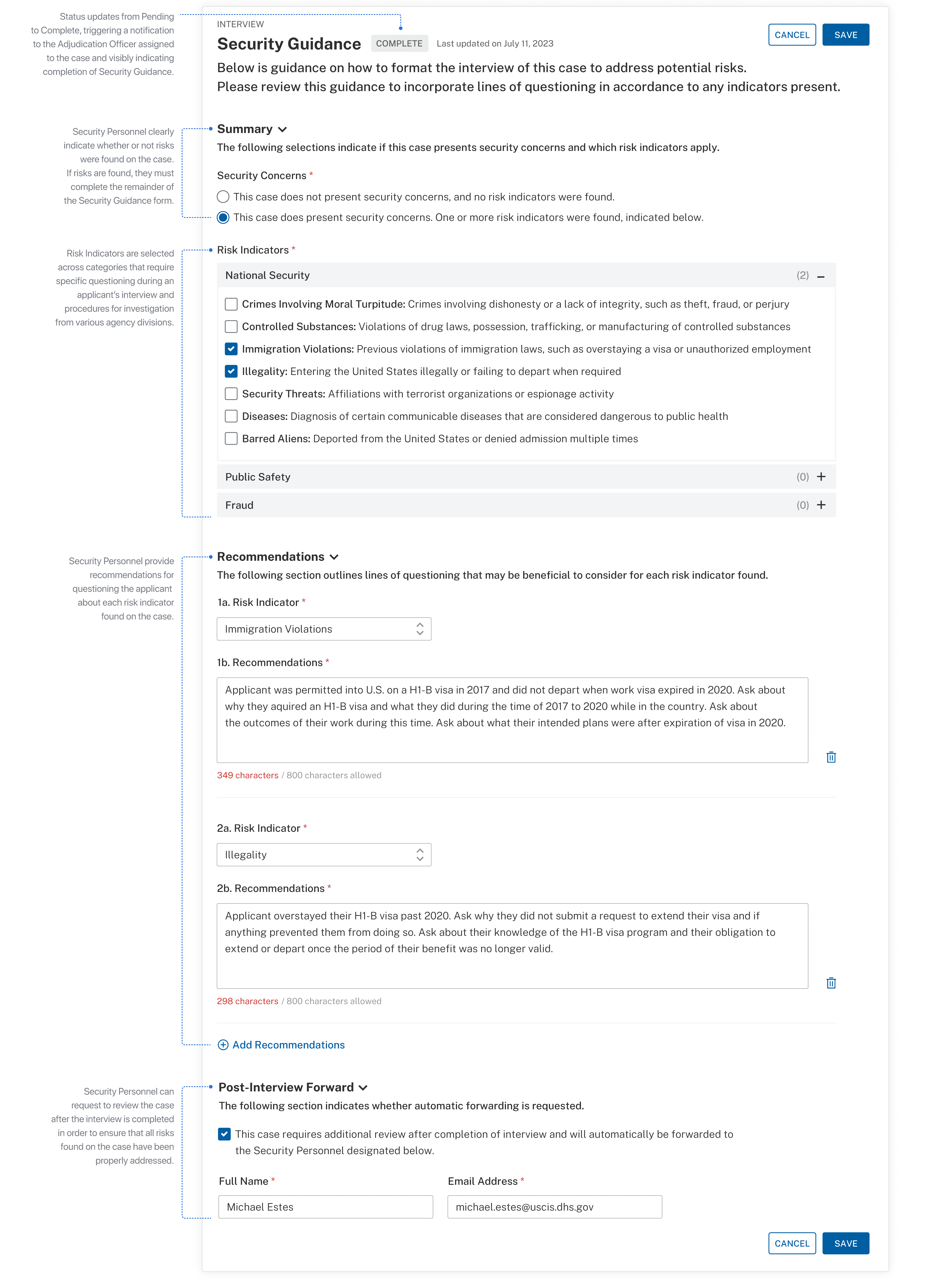
To strengthen security screenings and help officers conduct interviews with confidence, we envisioned a digital tool that would:
• Give guidance early: Deliver security details to officers well before interviews, so they have time to prepare.
• Offer smart suggestions: Provide tailored questions based on risk factors, helping officers dig deeper where it matters most.
• Support follow-up: Make it easier to review complex cases after interviews, ensuring no potential risks are overlooked.
By building a dedicated form in the Global system, we made it simpler for security teams to assess high-risk cases and give officers the clear, timely guidance they need. This means interviews are more thorough, screenings are more accurate, and everyone can feel more confident in the process.
With critical communication needing to occur across officers, we designed a workflow that would ensure timely coordination.
To strengthen security screenings and help officers conduct interviews with confidence, we envisioned a digital tool that would:
Give guidance early: Deliver security details to officers well before interviews, so they have time to prepare.
Offer smart suggestions: Provide tailored questions based on risk factors, helping officers dig deeper where it matters most.
Support follow-up: Make it easier to review complex cases after interviews, ensuring no potential risks are overlooked.
By building a dedicated form in the Global system, we made it simpler for security teams to assess high-risk cases and give officers the clear, timely guidance they need. This means interviews are more thorough, screenings are more accurate, and everyone can feel more confident in the process.
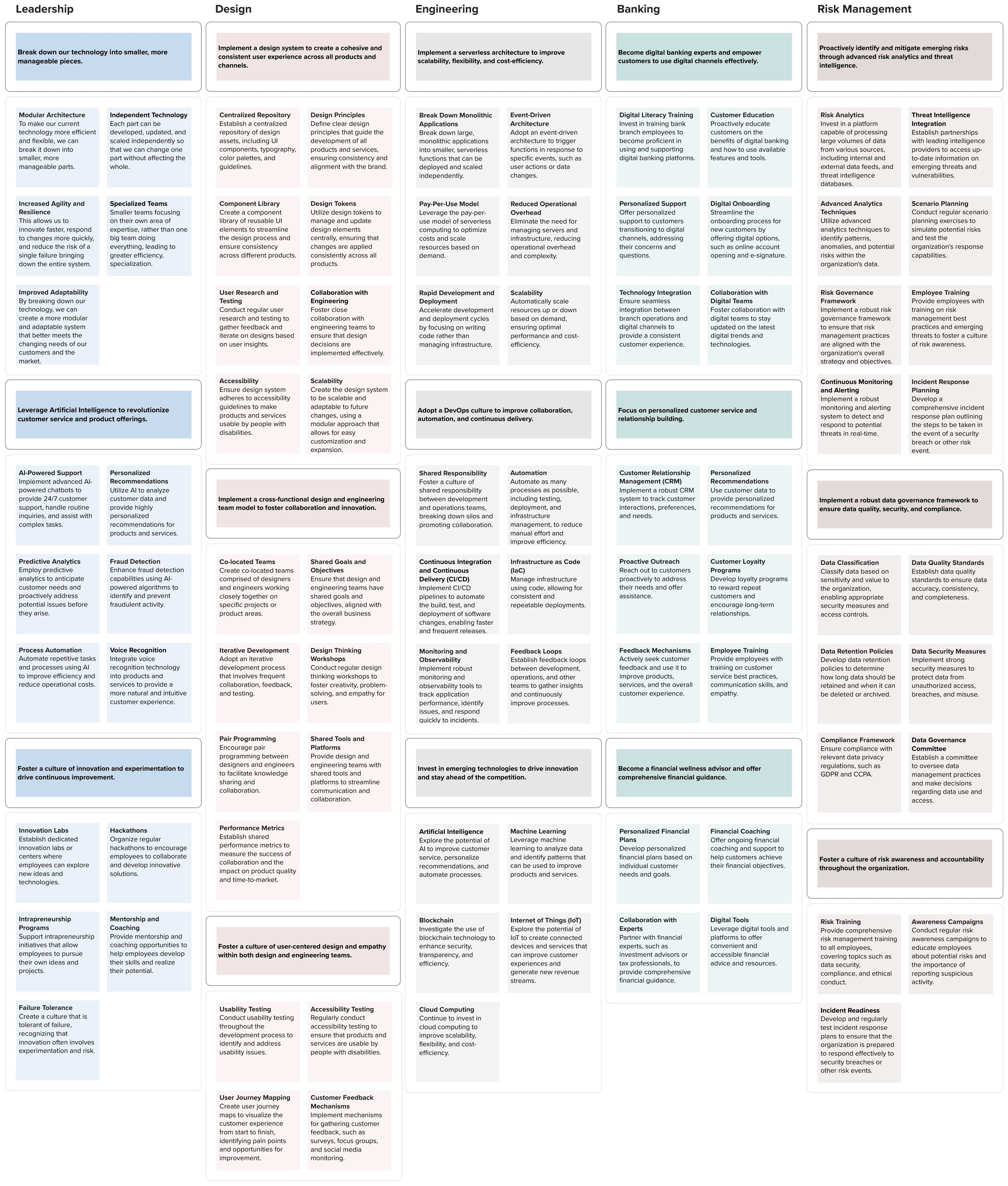
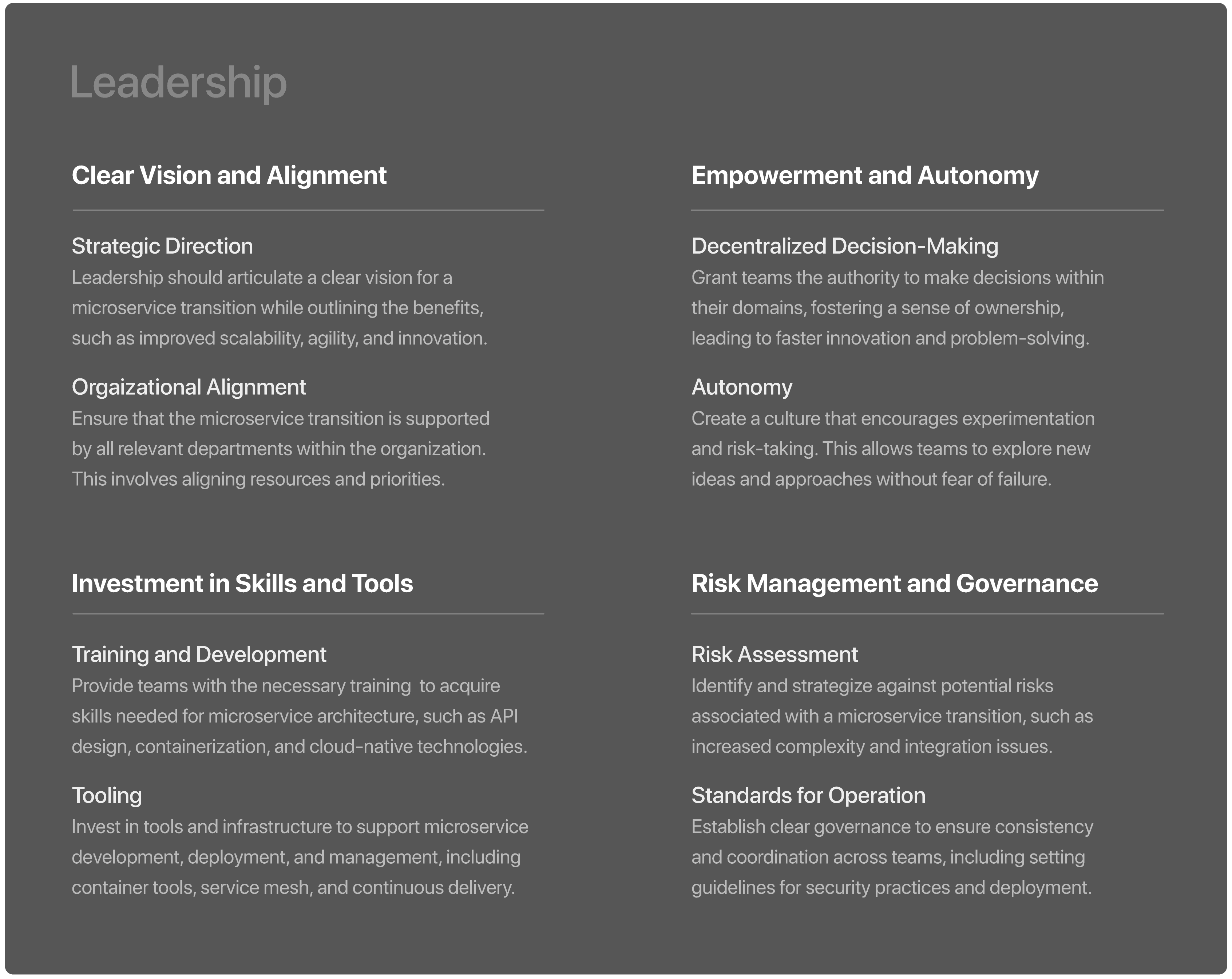
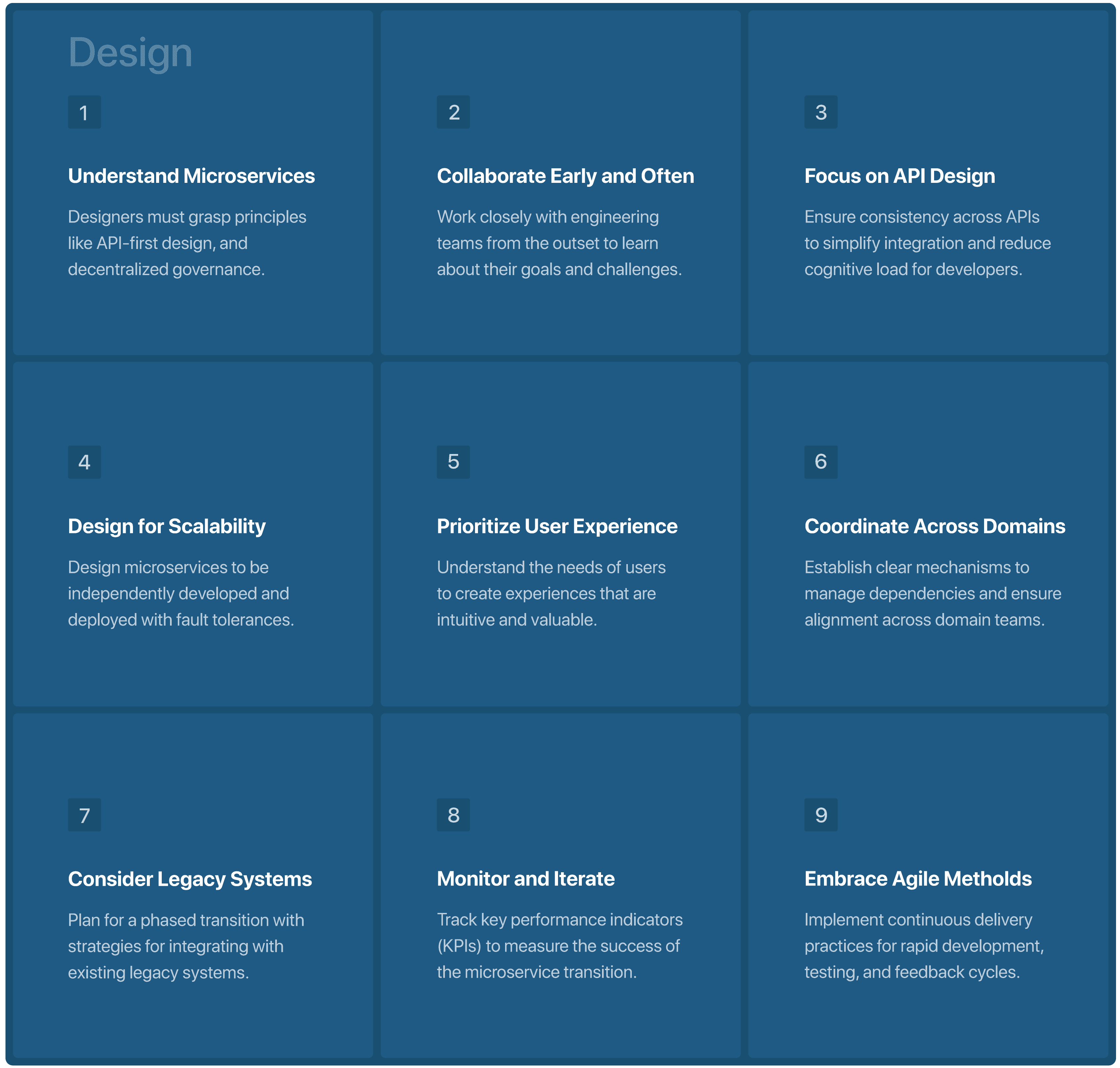
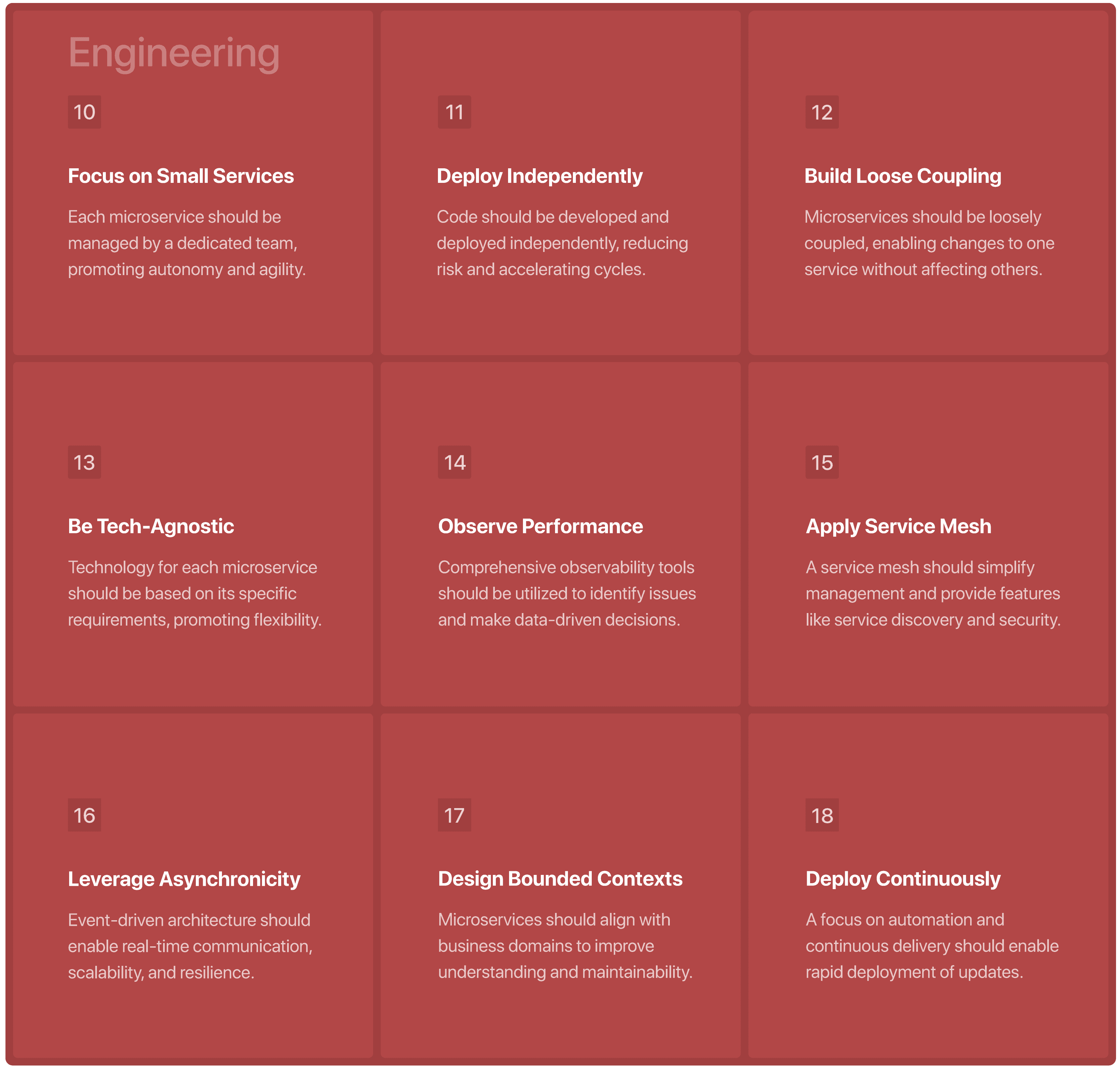
Our efforts led to a detailed technology roadmap that outlined actionable priorities.
Enhanced Cross-Functional Collaboration
Increased collaboration and alignment between leadership, product teams, bankers, and risk management, resulting in a 20% reduction in time-to-market for new products and services.
Developed a Clear Future Vision
Established a shared vision and strategic roadmap, leading to a 30% increase in employee engagement and a 25% increase in executive sponsorship for digital transformation initiatives.
Accelerated Digital Transformation
Enabling a successful transition of applications to a microservices architecture, resulting in a 20% increase in system reliability and a 15% reduction in maintenance costs.
Empowered Teams
Implemented new processes and tools to empower teams, leading to a 10% increase in employee productivity and a 5% reduction in employee turnover.
Our efforts led to a detailed technology roadmap that outlined actionable priorities.
Enhanced Cross-Functional Collaboration
Increased collaboration and alignment between leadership, product teams, bankers, and risk management, resulting in a 20% reduction in time-to-market for new products and services.
Developed a Clear Future Vision
Established a shared vision and strategic roadmap, leading to a 30% increase in employee engagement and a 25% increase in executive sponsorship for digital transformation initiatives.
Accelerated Digital Transformation
Enabling a successful transition of applications to a microservices architecture, resulting in a 20% increase in system reliability and a 15% reduction in maintenance costs.
Empowered Teams
Implemented new processes and tools to empower teams, leading to a 10% increase in employee productivity and a 5% reduction in employee turnover.
Please note: Data for this internal initiative isn't publicly disclosed. Specific percentages were measured by
our team in collaboration with DHS. All percentages presented here are representative of performance results.
Please note: Data for this internal initiative isn't publicly disclosed. Specific percentages were measured by our team in collaboration with DHS. All percentages presented here are representative of performance results.
Along with drastically decreasing adjudication times, we delivered the largest backlog reduction that DHS had experienced in over a decade.
Faster case processing
By simplifying workflows and cutting manual tasks, we reduced average case processing times by 40%.
Stronger security checks
With better tech and data sharing, we increased timely detection of fraudulent applications by 30% and reduced the average time spent on security vetting by 60%.
Smarter case management
Moving to a digital system and connecting agencies cut paper use by 80% and boosted data accuracy.
Empowered officers
We trained RAIO and FDNS teams through live demos, video tutorials, and clear guides, ensuring they were ready for every update.
Confident teams
By giving officers the tools and training they needed, job satisfaction ratings increased by 45%.
Role and Team
As the Experience & Product Design Lead, I combined strategic vision with hands-on execution. In my role I led
in-depth research and design sprints to understand user needs and design innovative solutions. I also led collaboration with over 130 stakeholders across DHS to align on goals and ensure successful implementation.
My responsibilities also included leading iteration planning and development to release features rapidly.
As team lead, I also mentored and guided UX designers and engineers across product teams. All work shown
in this case study has been made by me to convey the work accomplished during this project.
Role and Team
As the Experience & Product Design Lead, I combined strategic vision with hands-on execution. In my role I led in-depth research and design sprints to understand user needs and design innovative solutions. I also led collaboration with over 130 stakeholders across DHS to align on goals and ensure successful implementation.
My responsibilities also included leading iteration planning and development to release features rapidly. As team lead, I also mentored and guided UX designers and engineers across product teams. All work shown in this case study has been made by me to convey the work accomplished during this project.
Day 1 | Understanding Our Purpose
· Welcome back participants and recap previous workshop
· Explore the organization's core purpose and values
· Reflect on personal and professional purpose
· Discuss alignment of individual and organizational purposes
· Co-create a shared vision for the future

Designing data-powered products and processes at DHS
Product Design
Our research revealed a need to centralize information, automate workflows, and enhance security measures.
For our solution, we focused on the following:
Centralized Data Platform
Consolidated information from various agencies into a single dashboard for efficient access
Automated Workflows
Streamlined processes by automating routine tasks, reducing manual effort
Enhance Security Measures
Implemented robust security measures to protect sensitive information
By integrating Global with other systems and creating the centralized dashboard shown below, we significantly streamlined background and security checks, reducing processing times, enhancing data security, and ultimately improving the overall efficiency of the asylum and refugee case management system.
To address the problems we uncovered, we designed a dashboard powered by a robust set of data integrations.
Our research showed we needed to bring information together, cut out repetitive tasks, and tighten security. Here’s how we tackled it:
• Centralized Data: We pulled data from different agencies into a single dashboard.
• Smarter Workflows: We automated routine tasks, freeing up time for officers to focus on what matters.
• Stronger Security: We added safeguards to protect sensitive information and keep the system secure.
By connecting Global with other systems and building this centralized dashboard, we made background and security checks faster, safer, and more efficient, helping asylum and refugee case management run smoother for everyone involved.
Enhanced Cross-Functional Collaboration
Increased collaboration and alignment between leadership, product teams, bankers, and risk management, resulting in a 20% reduction in time-to-market for new products and services.
Developed a Clear Future Vision
Established a shared vision and strategic roadmap, leading to a 30% increase in employee engagement and a 25% increase in executive sponsorship for digital transformation initiatives.
Accelerated Digital Transformation
Enabling a successful transition of applications to a microservices architecture, resulting in a 20% increase in system reliability and a 15% reduction in maintenance costs.
Empowered Teams
Implemented new processes and tools to empower teams, leading to a 10% increase in employee productivity and a 5% reduction in employee turnover.
Results
Asylum Officers are responsible for completing meticulous interviews with asylum seekers, reviewing supporting documentation, and making informed decisions about whether to grant or deny asylum. This involves applying multifaceted legal standards, assessing credibility, and ensuring national security. Challenges in this role include managing a high caseload, navigating language barriers, and ensuring accuracy in decision-making. Additionally, staying updated on evolving immigration laws and policies is essential to effectively adjudicate cases.
Results
Faster case processing
By simplifying workflows and cutting manual tasks, we reduced average case processing times by 40%.
Stronger security checks
With better tech and data sharing, we increased timely detection of fraudulent applications by 30% and reduced the average time spent on security vetting by 60%.
Smarter case management
Moving to a digital system and connecting agencies cut paper use by 80% and boosted data accuracy.
Empowered officers
We trained RAIO and FDNS teams through live demos, video tutorials, and clear guides, ensuring they were ready for every update.
Confident teams
By giving officers the tools and training they needed, job satisfaction ratings increased by 45%.
Along with drastically decreasing adjudication times, we delivered the largest backlog reduction that DHS had experienced in over a decade.
Faster case processing
By simplifying workflows and cutting manual tasks, we reduced average case processing times by 40%.
Stronger security checks
With better tech and data sharing, we increased timely detection of fraudulent applications by 30% and reduced the average time spent on security vetting by 60%.
Smarter case management
Moving to a digital system and connecting agencies cut paper use by 80% and boosted data accuracy.
Empowered officers
We trained RAIO and FDNS teams through live demos, video tutorials, and clear guides, ensuring they were ready for every update.
Confident teams
By giving officers the tools and training they needed, job satisfaction ratings increased by 45%.
Please note: Data for this internal initiative isn't publicly disclosed. Specific percentages were measured by our team in collaboration with DHS. All percentages presented here are representative of performance results.
Please note: Data for this internal initiative isn't publicly disclosed. Specific percentages were measured by our team in collaboration with DHS. All percentages presented here are representative
of performance results.
Team
As Product Design and Development Lead, I combined strategic vision with hands-on execution. In my role I led in-depth research and design sprints to understand user needs and design innovative solutions. I also led collaboration with over 130 stakeholders across DHS to align on goals and ensure successful implementation.
My responsibilities also included leading iteration planning and development to release features rapidly. As team lead, I also mentored and guided four UX designers and four engineers.
Role and Team
As the Experience & Product Design Lead, I combined strategic vision with hands-on execution. In my role I led in-depth research and design sprints to understand user needs and design innovative solutions. I also led collaboration with over 130 stakeholders across DHS to align on goals and ensure
successful implementation.
My responsibilities also included leading iteration planning and development to release features rapidly. As team lead, I also mentored and guided UX designers and engineers across product teams. All work shown in this case study has been made by me to convey the work accomplished during this project.
Product Design
To strengthen security screenings and help officers conduct interviews with confidence,
we envisioned a digital tool that would:
• Give guidance early: Deliver security details to officers well before interviews.
• Offer smart suggestions: Provide tailored questions based on risk factors.
• Support follow-up: Make it easier to review complex cases after interviews.
By building a dedicated form in the Global system, we made it simpler for security teams to assess high-risk cases and give officers the clear, timely guidance they need. This means interviews are more thorough, screenings are more accurate, and everyone can feel more confident in the process.
With critical coordination needing across officers, we made a workflow to ensure timely communication.
To strengthen security screenings and help officers conduct interviews with confidence,
we envisioned a digital tool that would:
• Give guidance early: Deliver security details to officers well before interviews.
• Offer smart suggestions: Provide tailored questions based on risk factors.
• Support follow-up: Make it easier to review complex cases after interviews.
By building a dedicated form in the Global system, we made it simpler for security teams to assess high-risk cases and give officers the clear, timely guidance they need. This means interviews are more thorough, screenings are more accurate, and everyone can feel more confident in the process.
Priority 2: Strengthening Security Guidance
While working to improve security screenings, we discovered a major gap: officers interviewing high-risk applicants often didn’t get the guidance they needed in time. The old paper-based system was slow and left officers scrambling to prepare. Here’s what we found:
• Paper was the problem: Critical security details were stuck in piles of paperwork causing delays.
• Guidance came too late: Officers often received important information after it was useful.
• Training fell short: Many officers didn’t have the tools or training to confidently handle high-risk cases.
Priority 2: Strengthening Security Guidance
While working to improve security screenings, we discovered a major gap: officers interviewing high-risk applicants often didn’t get the guidance they needed in time. The old paper-based system was slow and left officers scrambling to prepare. Here’s what we found:
• Paper was the problem: Critical security details were stuck in piles of paperwork causing delays.
• Guidance came too late: Officers often received important information after it was useful.
• Training fell short: Many officers didn’t have the tools or training to confidently handle high-risk cases.
Research Insights
We spent time talking to officers, listening to their daily struggles, and learning where the system was falling short. Their insights shaped our vision for a better way to deliver security guidance—one that’s faster, clearer, and more helpful when it matters most.
Our research taught us the exacting nature of coordination needed
across officers.
We spent time talking to officers, listening to their daily struggles, and learning where the system was falling short. Their insights shaped our vision for a better way to deliver security guidance, one that’s faster, clearer, and more helpful when it matters most.
Priority 2: Strengthening Security Guidance
While working to improve security screenings, we discovered a major gap: officers interviewing high-risk applicants often didn’t get the guidance they needed in time. The old paper-based system was slow and left officers scrambling to prepare. Here’s what we found:
• Paper was the problem: Critical security details were stuck in piles of paperwork causing delays.
• Guidance came too late: Officers often received important information after it was useful.
• Training fell short: Many officers didn’t have the tools or training to confidently handle high-risk cases.
Priority 2:
Strengthening Security Guidance
While working to improve security screenings, we discovered a major gap: officers interviewing high-risk applicants often didn’t get the guidance they needed in time. The old paper-based system was slow and left officers scrambling to prepare. Here’s what we found:
Paper was the problem: Critical security details were stuck in piles of paperwork causing delays.
Guidance came too late: Officers often received important information after it was useful.
Training fell short: Many officers didn’t have the tools or training to confidently handle high-risk cases.
Other Projects
Service Blueprinting to Identify Challenges
Day 1 | Mapping the Journey Service Friction
• Welcome participants and set the stage for the workshop
• Present keynote on emerging trends and impacts on banking
• Conduct breakout sessions teams to identify challenges
• Share insights from breakout sessions in a plenary session
• Map service delivery along customer journey to identify pains
Day 2 | Diagnosing Identified Challenges
• Use a World Café format to brainstorm solutions for challenges
• Prioritize challenges and develop an action plan
• Apply design thinking to ideate innovative solutions
• Conclude with a review of key insights and next steps
Setting Goals and Prioritizing Actions
Day 1 | Aligning Our Objectives
• Welcome back participants and recap previous workshop
• Explore the organization's core purpose and values
• Reflect on and share out individual teams' purposes
• Align on new individual teams' and organizational goals
• Co-create a shared set of goals for service improvements
Day 2 | Roadmapping Cross-Functional Actions
• Define actions for individual teams to realize goals
• Prioritize based on impacts and strategic objectives
• Develop detailed action plans for individual teams
• Engage in team-building activities to foster camaraderie
• Recap key takeaways and commit to action
Defining Cross-functional Practices
Day 1 | Envisioning and Enabling the Future
• Welcome back participants and recap previous workshop
• Explore industry trends and their impact
• Breakout sessions to identify team-specific capabilities
• Share insights and identify common themes
• Create a unified vision for the future of Capital One
Defining Cross-functional Practices
Day 1 | Envisioning and Enabling the Future
• Welcome back participants and recap previous workshop
• Explore industry trends and their impact
• Breakout sessions to identify team-specific capabilities
• Share insights and identify common themes
• Create a unified vision for the future of Capital One
Day 2 | Defining Practices for improved Service Delivery
• Brainstorm innovative solutions and explore emerging technologies
• Form cross-functional teams to develop solutions
• Prioritize initiatives and develop an action plan
• Create detailed action plans with timelines and responsibilities
Day 2 | Defining Practices for Improved Service Delivery
• Brainstorm innovative solutions and explore emerging technologies
• Explore cross-functional principles to set a shared language
• Define practices by function that align and empower collaboration
• Outline leadership objectives to support service improvements
Navigating the Future of Banking
Day 1 | Understanding the Landscape
• Welcome participants and set the stage for the workshop
• Present keynote on emerging trends and impacts on banking
• Conduct breakout sessions teams to identify challenges
• Share insights from breakout sessions in a plenary session
• Map customer journey to identify pains and opportunities
Day 2 | Understanding the Landscape
• Use a World Café format to brainstorm solutions for challenges
• Prioritize challenges and develop an action plan
• Apply design thinking to ideate innovative solutions
• Conclude with a review of key insights and next steps
Service Blueprinting to Identify Challenges
Day 1 | Mapping the Journey and Service Friction
• Welcome participants and set the stage for the workshop
• Present keynote on emerging trends and impacts on banking
• Conduct breakout sessions teams to identify challenges
• Share insights from breakout sessions in a plenary session
• Map customer journey to identify pains and opportunities
Day 2 | Diagnosing Identified Challenges
• Use a World Café format to brainstorm solutions for challenges
• Prioritize challenges and develop an action plan
• Apply design thinking to ideate innovative solutions
• Conclude with a review of key insights and next steps
Igniting Purpose and Driving Impact
Day 1 | Understanding Our Purpose
• Welcome back participants and recap previous workshop
• Explore the organization's core purpose and values
• Reflect on personal and professional purpose
• Discuss how individual and organizational purpose
• Co-create a shared vision for the future
Day 2 | Setting Goals and Prioritizing Actions
• Set goals aligned with the organization's purpose and vision
• Prioritize based on impacts and strategic objectives
• Develop detailed action plans
• Engage in team-building activities to foster camaraderie
• Recap key takeaways and commit to action
Setting Goals and Prioritizing Actions
Day 1 | Aligning Our Objectives
• Welcome back participants and recap previous workshop
• Explore the organization's core purpose and values
• Reflect on personal and professional purpose
• Discuss how individual and organizational purpose
• Co-create a shared vision for the future
Day 2 | Roadmapping Cross-functional Actions
• Set goals aligned with the organization's purpose and vision
• Prioritize based on impacts and strategic objectives
• Develop detailed action plans
• Engage in team-building activities to foster camaraderie
• Recap key takeaways and commit to action
Team
As Service Design Lead, I spearheaded field research, conducted interviews, and facilitated workshops to gain deep insights into user needs. I also provided product design and development expertise, guiding client teams towards innovative solutions.
Our team included two Service Designers who supported research synthesis and workshop facilitation. A dedicated Client Coordinator managed project administration and coordination with Capital One.
Role and Team
As Service Design Lead, I spearheaded field research, led interviews, and led the facilitation of workshops to gain deep insights into customer and employee needs. I also provided product design and development expertise, guiding client teams towards innovative solutions.
My team included a Service Designer, UX Designer, and Product Manager. A dedicated Client Coordinator managed project administration and coordination with Capital One. All work shown in this case study has been made by me to convey the work accomplished during this project.
Results
Enhanced Cross-Functional Collaboration
Increased collaboration and alignment between leadership, product teams, bankers, and risk management, resulting in a 20% reduction in time-to-market for new products and services.
Developed a Clear Future Vision
Established a shared vision and strategic roadmap, leading to a 30% increase in employee engagement and a 25% increase in executive sponsorship for digital transformation initiatives.
Accelerated Digital Transformation
Enabling a successful transition of applications to a microservices architecture, resulting in a 20% increase in system reliability and a 15% reduction in maintenance costs.
Empowered Teams
Implemented new processes and tools to empower teams, leading to a 10% increase in employee productivity and a 5% reduction in employee turnover.
Our efforts led to a detailed technology roadmap that outlined actionable priorities.
Enhanced Cross-Functional Collaboration
Increased collaboration and alignment between leadership, product teams, bankers, and risk management, resulting in a 20% reduction in time-to-market for new products and services.
Developed a Clear Future Vision
Established a shared vision and strategic roadmap, leading to a 30% increase in employee engagement and a 25% increase in executive sponsorship for digital transformation initiatives.
Accelerated Digital Transformation
Enabling a successful transition of applications to a microservices architecture, resulting in a 20% increase in system reliability and a 15% reduction in maintenance costs.
Empowered Teams
Implemented new processes and tools to empower teams, leading to a 10% increase in employee productivity and a 5% reduction in employee turnover.
Please note: Data for this internal initiative isn't publicly disclosed. Specific percentages were measured by our team in collaboration with Capital One. All percentages presented here are representative of performance results.
Navigating the Future of Banking
Day 1 | Understanding the Landscape
• Welcome participants and set the stage for the workshop
• Present keynote on emerging trends and impacts on banking
• Conduct breakout sessions teams to identify challenges
• Share insights from breakout sessions in a plenary session
• Map customer journey to identify pains and opportunities
Day 2 | Understanding the Landscape
• Use a World Café format to brainstorm solutions for challenges
• Prioritize challenges and develop an action plan
• Apply design thinking to ideate innovative solutions
• Conclude with a review of key insights and next steps
Navigating the Future of Banking
Day 1 | Understanding the Landscape
• Welcome participants and set the stage
• Present keynote on emerging trends in banking
• Conduct breakout sessions to identify challenges
• Share insights from breakout sessions as a group
• Map customer journeys
Day 2 | Understanding the Landscape
• Use a World Café format to brainstorm solutions
• Prioritize challenges and develop an action plan
• Apply design thinking to ideate on innovations
• Review key insights and next steps
Innovating for the Future
Day 1 | Understanding the Present and Future
• Welcome back participants and recap previous workshop
• Explore industry trends and their impact
• Breakout sessions to identify team-specific capabilities
• Share insights and identify common themes
• Create a unified vision for the future of Capital One
Day 2 | Ideation and Action Planning
• Brainstorm innovative solutions and explore emerging technologies
• Form cross-functional teams to develop solutions
• Prioritize initiatives and develop an action plan
• Create detailed action plans with timelines and responsibilities
Igniting Purpose and Driving Impact
Day 1 | Understanding Our Purpose
• Welcome back participants and recap
• Explore the organization's core purpose
• Reflect on personal and professional purpose
• Discuss individual and organizational purposes
• Co-create a shared vision for the future
Day 2 | Setting Goals and Prioritizing Actions
• Set goals aligned with the organization's purpose
• Prioritize based on strategic objectives
• Develop detailed action plans
• Engage in team-building activities
• Recap key takeaways and commit to action
Innovating for the Future
Day 1 | Understanding the Present and Future
• Welcome back participants and recap previous workshop
• Explore industry trends and their impact
• Breakout sessions to identify team-specific capabilities
• Share insights and identify common themes
• Create a unified vision for the future of Capital One
Day 2 | Ideation and Action Planning
• Brainstorm innovative solutions and explore emerging technologies
• Form cross-functional teams to develop solutions
• Prioritize initiatives and develop an action plan
• Create detailed action plans with timelines and responsibilities
Innovating for the Future
Day 1 | Understanding the Present and Future
• Welcome back participants and recap
• Explore industry trends and their impact
• Breakout sessions to identify team capabilities
• Share insights and identify common themes
• Create a unified vision for future of Capital One
Day 2 | Ideation and Action Planning
• Brainstorm solutions with emerging technology
• Form cross-functional teams to shape solutions
• Prioritize initiatives and develop an action plan
• Create detailed action plans and timelines
Results
Enhanced Cross-Functional Collaboration
Increased collaboration and alignment between leadership, product teams, bankers, and risk management, resulting in a 20% reduction in time-to-market for new products and services.
Developed a Clear Future Vision
Established a shared vision and strategic roadmap, leading to a 30% increase in employee engagement and a 25% increase in executive sponsorship for digital transformation initiatives.
Accelerated Digital Transformation
Enabling a successful transition of applications to a microservices architecture, resulting in a 20% increase in system reliability and a 15% reduction in maintenance costs.
Empowered Teams
Implemented new processes and tools to empower teams, leading to a 10% increase in employee productivity and a 5% reduction in employee turnover.
Our efforts led to a detailed technology roadmap that outlined actionable priorities.
Enhanced Cross-Functional Collaboration
Increased collaboration and alignment between leadership, product teams, bankers, and risk management, resulting in a 20% reduction in time-to-market for new products and services.
Developed a Clear Future Vision
Established a shared vision and strategic roadmap, leading to a 30% increase in employee engagement and a 25% increase in executive sponsorship for digital transformation initiatives.
Accelerated Digital Transformation
Enabling a successful transition of applications to a microservices architecture, resulting in a 20% increase in system reliability and a 15% reduction in maintenance costs.
Empowered Teams
Implemented new processes and tools to empower teams, leading to a 10% increase in employee productivity and a 5% reduction in employee turnover.
Please note: Data for this internal initiative isn't publicly disclosed. Specific percentages were measured by our team in collaboration with Capital One. All percentages presented here are representative of performance results.
Team
As Service Design Lead, I spearheaded field research, conducted interviews, and facilitated workshops to gain deep insights into user needs. I also provided product design and development expertise, guiding client teams towards innovative solutions.
Our team included two Service Designers who supported research synthesis and workshop facilitation. A dedicated Client Coordinator managed project administration and coordination with Capital One.
Role and Team
As Service Design Lead, I spearheaded field research, led interviews, and led the facilitation of workshops to gain deep insights into customer and employee needs. I also provided product design and development expertise, guiding client teams towards innovative solutions.
My team included a Service Designer, UX Designer, and Product Manager. A dedicated Client Coordinator managed project administration and coordination with Capital One. All work shown in this case study has been made by me to convey the work accomplished during this project.